Description
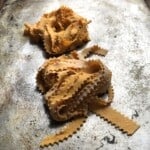
This homemade pumpkin pasta dough recipe makes fresh egg pasta with a beautiful orange color and delicate pumpkin flavor. Perfect for fettuccine, lasagna, ravioli, and more! Ready in under 1 hour (and that includes 30 minutes of hands-off resting time!) with simple ingredients: 00 flour, semolina flour, eggs, canned pumpkin (or puree), and olive oil.
Ingredients
- 150g twice-milled semolina flour (semola rimacinata) (sub regular semolina flour)
- 250g 00 flour
- 150g (5.3 oz / about 2/3 cup) Libby's canned pumpkin (sub homemade Hokkaido or Delica pumpkin purée)
- 2 large eggs, room temperature (100g)
- 15g extra virgin olive oil (1 tablespoon)
Instructions
- Make the dough. On a clean work surface or in a large bowl, combine the 00 flour and semolina flour and whisk well to combine. Make a well in the center. In a small bowl, whisk together the eggs and pumpkin puree, and add this and the olive oil into the well of the flour.
- Bring it together. Using a fork (or your hands), start combining the wet ingredients, gradually pulling in flour from the sides of the well into the center. Keep mixing in a circular motion, incorporating more flour as you go. When the mixture becomes too thick and shaggy to mix using the fork, switch to using your hands.
- Knead the dough. Bring the dough together into a shaggy mass. The dough should feel slightly soft, like Play-Do,h but not sticky. If it sticks to your hands, dust very lightly with flour (1/2 tablespoon at a time). If the dough feels too dry and won't come together, wet your hands slightly and continue kneading to add moisture gradually. Knead the dough on your work surface (or in the bowl of a stand mixer fitted with the dough hook attachment on low-medium) for 10-12 minutes until visibly smoother.
- Rest the dough (essential!). Form the dough into a ball, cover with a glass bowl, and let it rest at room temperature for 30 minutes. This resting time allows the gluten to relax, making the dough much easier to roll out thin without springing back. You can rest it for up to 1 hour at room temperature.
- Divide and roll. After resting, divide the dough into 4 equal pieces (about 160g each). Keep the pieces you're not working with covered under a bowl to prevent drying. Working with one piece at a time, flatten it slightly with your hands on a lightly floured surface.
- Roll out the pasta with a machine OR a rolling pin. Using a pasta machine: Flatten one dough piece slightly with your hands and dust it lightly with flour. Set your pasta machine to the widest setting (#1 on a Marcato Atlas). Feed the dough through once. Fold the dough into thirds like a letter, dust lightly with flour again, then feed it through the widest setting again—this creates a uniform rectangular shape. Roll it progressively thinner by feeding it through each narrower setting one time, working your way from setting #2 through #6 or your preferred thickness. Dust with flour as needed between settings to prevent sticking. *See recipe notes if using a rolling pin
- Cut your pasta. Once rolled thin, cut the dough into your desired shape. For fettuccine, cut strips about 1/4 inch (6mm) wide. For pappardelle, cut wider strips at 3/4 to 1 inch (2-2.5cm) wide; for chitarra pasta, use a chitarra tool. You can also use this dough for ravioli, tortellini, or lasagna sheets. Transfer cut pasta to a floured baking sheet, tossing gently with a bit more semolina or 00 flour to prevent sticking, and let it rest for up to 30 minutes if cooking it the same day. If not using it right away, check out the Storage Section in the main post below for how to freeze it.
- Cook the pasta. Bring a large pot of salted water to a rolling boil, add the pasta, stir gently to prevent sticking, and cook for about 2 minutes until al dente. Fresh pumpkin pasta cooks quickly, usually 2-3 minutes. It's done when the pasta floats to the top and tastes tender with a slight bite (al dente). If cooking from frozen, add just 1 extra minute. Drain immediately, reserving a little pasta cooking water to help your sauce cling to the noodles.
Notes
If using a rolling pin: On a lightly floured surface, roll the dough from the center outward, rotating frequently to maintain even thickness. Dust the dough and surface with flour as needed to prevent sticking. Your goal is to roll it very thin—about 1/16 inch thick, or thin enough that you can almost see your hand through it when you hold it up to the light. This is thinner than pie crust! Don't worry if it feels too thin—fresh pasta thickens considerably when it cooks. Use only as much flour as needed to prevent sticking; too much flour can make the pasta tough.
I typically use setting #6 for fettuccine, pappardelle, tagliatelle, tortellini, and lasagna sheets, #5 or #6 for chitarra pasta, and sometimes #7 for ultra-thin tagliatelle and #7 or #8, or ravioli. The dough should be thin enough to almost see your hand through it, preventing overly thick cooked pasta.
If you're unfamiliar with how thick or thin you want your pasta, test it by rolling and boiling a couple of pieces first before rolling out the entire batch.
- Prep Time: 20 minutes
- Rest Time: 30 minutes
- Cook Time: 3 minutes
- Category: Pasta
- Method: Knead & Roll
- Cuisine: Italian
Nutrition
- Serving Size: 3 ounces/80g
- Calories: 210g
- Sugar: 1g
- Sodium: 18g
- Fat: 4g
- Saturated Fat: 1g
- Unsaturated Fat: 3g
- Trans Fat: 0g
- Carbohydrates: 35g
- Fiber: 2g
- Protein: 8g
- Cholesterol: 45mg